Acrylamide: Properties, Reactions, Production, Uses and Toxicology
What is acrylamide?
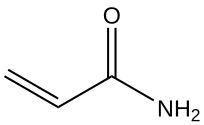
Acrylamide, also known as prop-2-enamide or acrylic acid amide, is a simple unsaturated amide with the molecular formula C3H5NO. It is a white, odorless crystalline solid that is highly soluble in water and polar organic solvents but insoluble in nonpolar solvents.
In its pure solid form, acrylamide is considered hazardous because it can generate fine toxic dust that is readily inhaled. For this reason, it is generally handled and transported as aqueous solutions. The compound is classified as a highly toxic substance and is known to be a probable human carcinogen.
Acrylamide is formed unintentionally in certain foods. It is produced through the Maillard reaction between reducing sugars and the amino acid asparagine when starchy foods are cooked at high temperatures, such as frying, baking, or roasting. This has raised concerns regarding dietary exposure to acrylamide in foods like fried potatoes, bread, and coffee.
Commercial production of acrylamide began in the mid-20th century, and since then it has become the most significant member of the acrylic and methacrylic amide family. Although its global production volume is relatively modest compared to bulk petrochemicals, acrylamide is a valuable industrial intermediate, primarily used in the synthesis of polyacrylamides.
1. Physical properties of acrylamide
Pure acrylamide is a white crystalline solid that is highly soluble in water and also dissolves in solvents such as methanol, ethanol, and acetone but is insoluble in benzene and heptane.
The acrylamide monomer is stable and does not undergo noticeable polymerization even when maintained at its melting point for extended periods in the absence of light. However, when heated beyond the melting point, the liquid rapidly polymerizes with considerable release of heat.
In addition to the solid monomer, acrylamide is widely marketed as a 50% aqueous solution stabilized with low concentrations of cupric ions, typically 25–30 ppm relative to the monomer, together with dissolved oxygen. Several alternative stabilizing agents are also used, including ethylenediaminetetraacetic acid (EDTA), ferric ions, and nitrites.
Oxygen acts only by extending the induction period prior to polymerization. For salt-containing solutions, stabilizers based on iron complexes of cyanogen or thiocyanogen are effective in suppressing premature reactions.
The principal physical properties of crystalline acrylamide, its solubility in various solvents, and the standard characteristics of a 50% aqueous solution are summarized in tables 1, 2, and 3.
Table 1: physical properties of crystalline acrylamide
| Property | Value |
|---|---|
| CAS number | 79-06-1 |
| Chemical formula | C3H5NO |
| Molecular weight | 71.08 |
| Melting point (°C) | 84.5 |
| Vapor pressure (Pa) |
25 °C: 0.9 40 °C: 4.4 50 °C: 9.3 |
| Boiling point (°C) |
0.27 kPa: 87 0.67 kPa: 103 1.4 kPa: 116.5 3.3 kPa: 136 |
| Heat of polymerization (kJ/mol) | −82.8 |
| Density (g/mL at 30 °C) | 1.122 |
| Equilibrium moisture content (particle size 355 µm, at 22.8 °C, 50% RH) | 1.7 g water/kg dry acrylamide |
| Crystal system | Monoclinic or triclinic |
| Crystal habit | Thin tabular to laminar |
| Refractive indexes |
nx = 1.460 (calcd) ny = 1.550 ± 0.003 nz = 1.581 ± 0.003 |
| Optic axial angles | 2E = 98°, 2V = 58° |
| Optic sign | (−) |
Table 2: solubility of acrylamide in various solvents
| Solvent | Solubility (g/100 mL) |
|---|---|
| Acetonitrile | 39.6 |
| Acetone | 63.1 |
| Benzene | 0.346 |
| Ethylene glycol monobutyl ether | 31 |
| Chloroform | 2.66 |
| 1,2-Dichloroethane | 1.50 |
| Dimethylformamide | 119 |
| Dimethyl sulfoxide | 124 |
| Dioxane | 30 |
| Ethanol | 86.2 |
| Ethyl acetate | 12.6 |
| n-Heptane | 0.0068 |
| Methanol | 155 |
| Pyridine | 61.9 |
| Water | 215.5 |
| Carbon tetrachloride | 0.038 |
Table 3: properties of a 50% aqueous acrylamide solution
| Property | Value |
|---|---|
| pH | 5.0–6.5 |
| Refractive index range (25 °C, 48–52%) | 1.4085–1.4148 |
| Viscosity (mPa·s at 25 °C) | 2.71 |
| Specific gravity (25 °C) | 1.0412 |
| Density (25/4 °C) | 1.038 |
| Crystallization point (°C) | 8–13 |
| Partial phase diagram: eutectic temperature (°C) | −8.9 |
| Eutectic composition (wt%) | 31.2 |
| Boiling point at 101.3 kPa (°C) | 99–104 |
| Vapor pressure | 2.407 kPa at 23 °C 27.93 kPa at 70 °C |
| Specific heat (20–50 °C), J/(g·K) | 3.47 |
| Heat of dilution to 20 wt%, J/g solution | −4.6 |
| Heat of polymerization (kJ/mol) | −85.4 |
| Heat of melting (solution), J/g | 247.7 |
| Melting range (°C) | −17.3 to +19.7 |
| Flammability | Nonflammable |
2. Chemical reactions of acrylamide
Acrylamide is a difunctional monomer characterized by an electron-deficient vinyl group and an amide functionality. The presence of the carboxamide group activates the double bond toward nucleophilic addition, while the amide moiety undergoes reactions typical of its class. As a result, acrylamide participates in a wide range of addition and substitution reactions. It shows both weakly acidic and basic behavior.
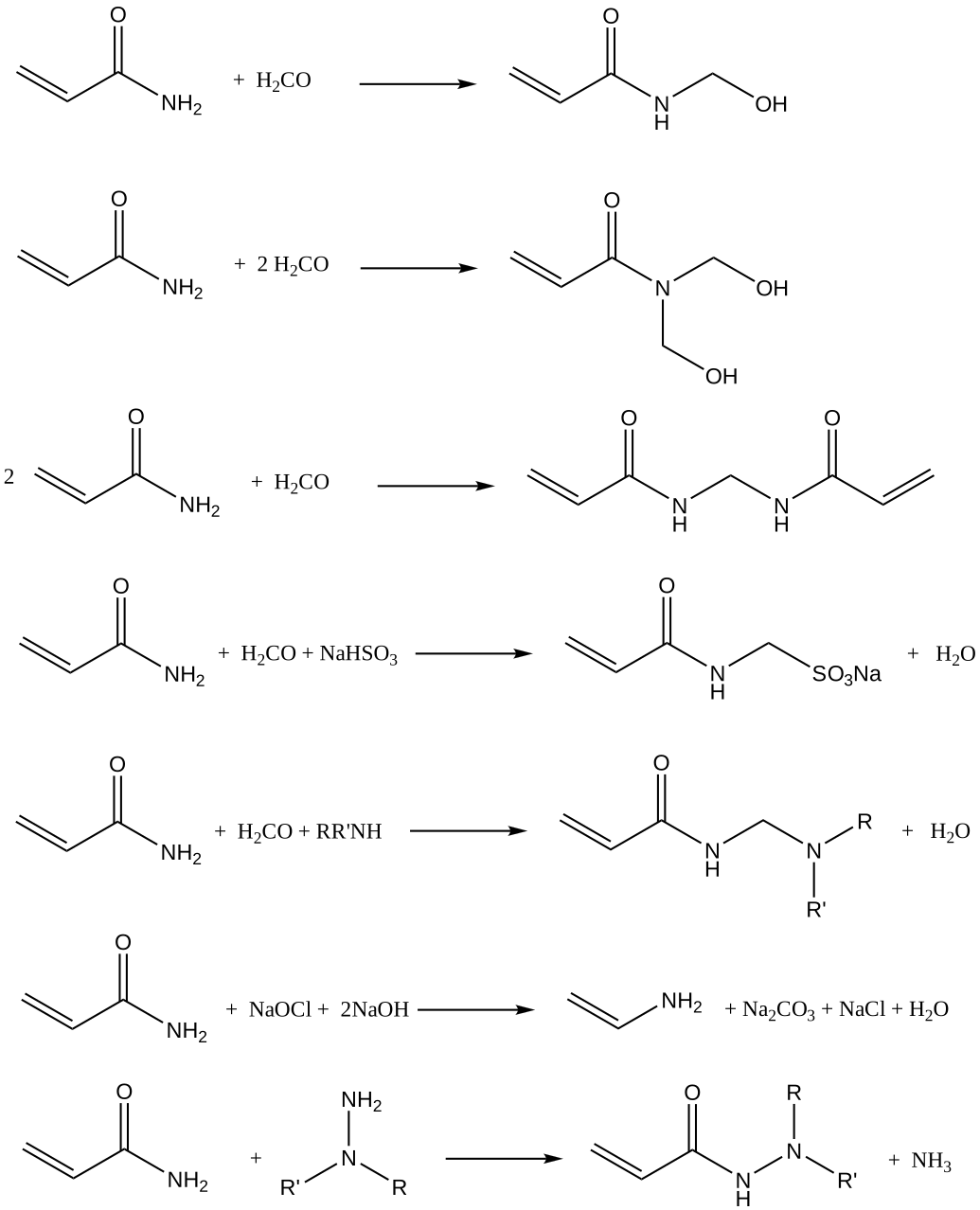
Ammonia, amines, phosphines, and bisulfite react readily with acrylamide to form addition products. Under alkaline conditions, mercaptans, sulfides, ketones, nitroalkanes, and alcohols also react. Examples of reactive alcohols include polymeric alcohols such as poly(vinyl alcohol), cellulose, and starch, although partial hydrolysis of the amide group often accompanies the reaction.
Primary amines form mono- or bis-adducts with acrylamide, whereas secondary amines yield only monosubstituted derivatives. These products are thermally reversible. Reaction with ammonia produces 3,3′,3′′-nitrilotrispropionamide, often detected as an impurity in crystalline acrylamide, where it influences radical polymerization.
Dialkylhydrazines, hydroxylamines, and nitramines also form characteristic adducts under appropriate conditions.
The addition of sodium sulfite or bisulfite to acrylamide yields sodium-β-sulfopropionamide, a reaction of industrial relevance because of its efficiency and the low toxicity of the product. Acrylamide also reacts with phosphines, phosphine oxides, sulfides, and dithiocarbamates, though practical applications are limited.
Water hydrolyzes the amide group of acrylamide to acrylic acid. Alcohols and phenols yield ether derivatives, while activated ketones form adducts that often cyclize to lactams, which can subsequently be hydrolyzed to substituted propionic acids.
Chlorine and bromine react with acrylamide in aqueous solution to produce α,β-dihalopropionamides. Hydrochloric acid and hydrobromic acid add across the double bond to form β-halopropionamides. These products are also thermally reversible.
Dienes undergo Diels–Alder reactions with acrylamide. Enamines and imines have been used in aza-annelation reactions to give an improved yield.
Catalytic hydrogenation with palladium, nickel boride, or rhodium carbonyl reduces acrylamide to propionamide. Oxidation with sodium hypochlorite in the presence of osmium tetroxide yields glycols, whereas in its absence the reaction occurs at the nitrogen atom to give N-vinyl-N′-acryloylurea.
Strong bases in aprotic media promote head-to-tail dimerization to form 3-acrylamidopropionamide. Electrolytic reduction of acrylamide produces adipamide through tail-to-tail coupling.
The most important reaction of acrylamide is the vinyl addition polymerization. Free-radical initiators, particularly redox systems such as sodium persulfate–bisulfite, are widely used. Aqueous polymerizations yield very high molecular weight polyacrylamides, while copolymerization with acrylates, methacrylates, or styrene is also common, although with lower molecular weights.
In basic or aprotic solvents, acrylamide can polymerize by hydrogen-transfer mechanisms to form poly(β-alanine) (nylon-3), which hydrolyzes to β-aminopropionic acid.
The amide group hydrolyzes to acrylic acid more rapidly in base than in acid. N-alkyl derivatives hydrolyze more slowly, although electron-withdrawing groups on nitrogen accelerate the process. Concentrated sulfuric acid yields acrylamide sulfate, an intermediate in older production methods. Further treatment with alcohols gives acrylate esters.
Strong bases in anhydrous solvents can produce potassium salts of acrylamide.
Acrylamide forms complexes with transition metals, nucleosides, and inorganic salts. Dehydration with manganese dioxide or phosphorus pentoxide yields acrylonitrile.
Formaldehyde reacts with acrylamide to give N-methylolacrylamide, which can condense further under acidic conditions to form N,N′-methylenebisacrylamide. N-Methylolacrylamide derivatives, such as ethers and condensation products with polyphenols, carbamates, or amines, are used as cross-linking agents or precursors to functional polymers.
The reaction of acrylamide with glyoxylic acid yields acrylamido-N-glycolic acid and diacrylamidoacetic acid. N-acylacrylamides, including diacrylamide and N-acetylacrylamide, are produced by reactions with acrylic anhydride, acryloyl chloride, or ketene.
N-substituted acrylamides are obtained by several routes, including the reaction of acryloyl chloride with primary or secondary amines, dehydrochlorination of 2-chloropropionamide, or direct amination of acrylic acid and its esters.
3. Industrial production of acrylamide
Acrylamide was first manufactured on an industrial scale in 1954 by American Cyanamid. Current production methods are based on the hydration of acrylonitrile, carried out either by sulfuric acid hydration or by catalytic hydration. A biocatalytic process has also been developed for commercial use.
3.1. Production of acrylamide by sulfuric acid hydration of acrylonitrile
In the traditional sulfuric acid process, one mole of acrylonitrile is reacted with one mole of sulfuric acid and one mole of water at 60 °C. The mixture is gradually heated to 80 °C and maintained for 1 h before cooling to 40 °C.
The process was carried out in glass-lined reactors, and careful control of reagent ratios was required to minimize impurities such as polymers and acrylic acid.
Neutralization with ammonia yielded ammonium sulfate, which is removed by filtration, while acrylamide was recovered either as a crystalline solid or in aqueous solution. When cooled to below 10 °C, acrylamide crystallizes from the mother liquor and is further purified by recrystallization from benzene.
Recovery of acrylamide was costly and waste-intensive. Two main recovery routes were used: crystallization after neutralization to ammonium sulfate or ion-exclusion chromatography using sulfonic acid ion-exchange resins.
Both methods generated dilute sulfuric acid waste streams. Disposal of by-products, especially ammonium sulfate, was a major limitation. For these reasons, no commercial acrylamide is produced today by the sulfuric acid process.
3.2. Production of acrylamide by catalytic hydration of acrylonitrile
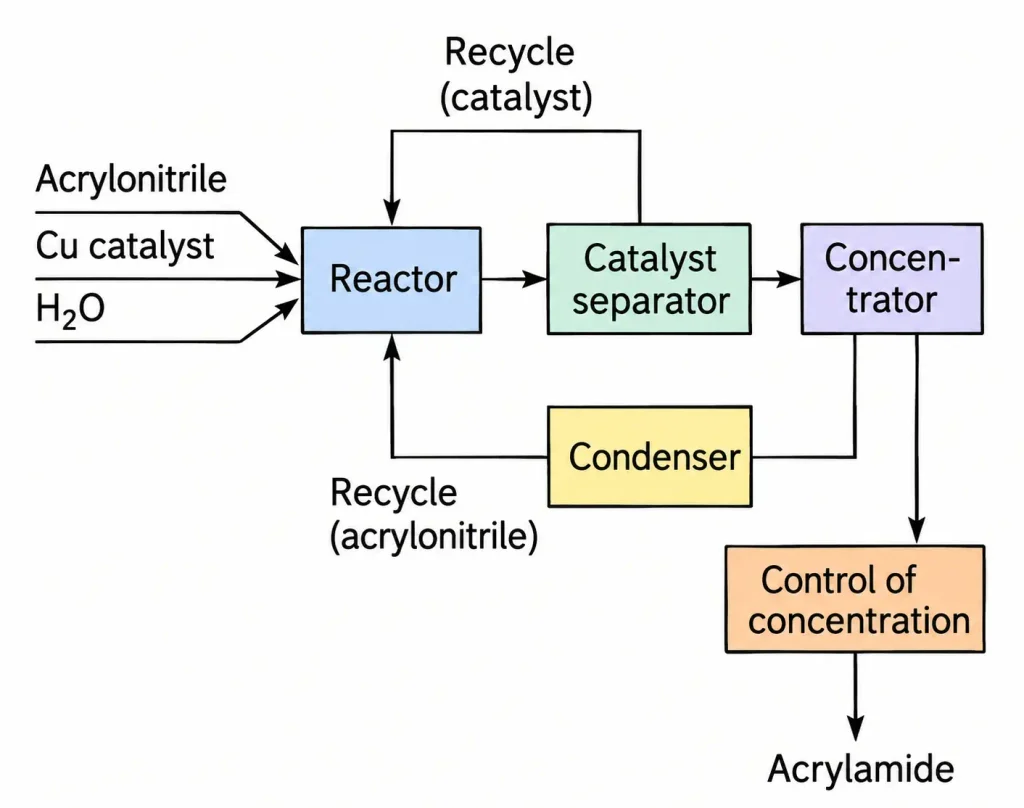
In the catalytic hydration process, a 50 wt% aqueous solution of acrylonitrile is treated with a heterogeneous catalyst, such as Raney copper, at 120 °C for 2.5 h. Conversion exceeds 50%, and the selectivity toward acrylamide is close to 100%. The process directly produces an aqueous acrylamide solution with a concentration of 30–50 wt% because of the large amount of water used.
Catalytic hydration was developed in the late 1960s as an alternative to acid hydration. Early attempts included the use of sulfonic acid ion-exchange resins, manganese dioxide, and copper ions in different valence states. Copper metal alone was not effective, and catalysts such as Urushibara or Ullmann copper, active for aromatic nitriles, showed no activity with aliphatic nitriles.
In 1971, Dow Chemical patented a copper-catalyzed process that became the industrial standard. In this method, aqueous acrylonitrile is passed over a fixed bed of copper catalyst at about 85 °C, yielding acrylamide in water with high conversion and nearly complete selectivity.
The process is highly efficient and produces minimal waste. Impurities are mainly related to nitriles in the feed or partial hydrolysis of acrylamide to acrylic acid and ammonia.
Mitsui Toatsu Chemical introduced a similar process based on Raney copper catalysts in 1971, and BASF developed its own copper catalyst variant in 1974. Numerous patents since then have described modifications of both heterogeneous and homogeneous catalytic systems.
Current producers worldwide, including Dow, American Cyanamid, Allied Colloids, Stockhausen, and others, use technologies based largely on the copper-catalyzed process. Nalco Chemical has developed slurry and fixed-bed versions of the Raney copper system, mainly for in-house monomer production.
3.3. Production of acrylamide by biocatalytic hydration of acrylonitrile
In 1985, Nitto Chemical Industry Co. (Tokyo) commercialized an enzymatic process using nitrile hydratase, a nitrile-converting enzyme produced by bacteria such as Corynebacterium, Bacillus, Micrococcus, Nocardia, Pseudomonas, and Rhodococcus.
The reaction proceeds at 0–15 °C and pH 7–9 under ambient pressure, giving nearly complete conversion of acrylonitrile with minimal by-products. This development marked one of the earliest applications of biocatalysis in large-scale petrochemical production.
Recent biotechnology processes use Rhodococcus rhodochrous strains, immobilized cells, and improved concentration methods for dilute product solutions. Production capacity by these methods has increased significantly, with plants expanding from 6000 to 20,000 t/year.
3.4. Alternative processes
Acrylamide and its derivatives can also be synthesized by other methods, although they are of limited commercial significance. Classical processes include the reaction of acryloyl chloride or acrylic anhydride with ammonia and the amination of methyl acrylate followed by thermal decomposition of intermediates such as 3,3′,3”-nitrilotrispropionamide.
Michael-type addition reactions of amines or alcohols with methyl acrylate, followed by ammonolysis, yield substituted propionamides that can be decomposed to acrylamide.
N-substituted acrylamides are prepared by reactions such as the Ritter reaction, acetylene–carbon monoxide–amine coupling catalyzed by transition-metal carbonyls, or direct amination. Examples include diacetoneacrylamide, 2-acrylamido-2-methyl-propanesulfonic acid, N-isopropylacrylamide, and N-tert-butylacrylamide.
4. Uses of acrylamide
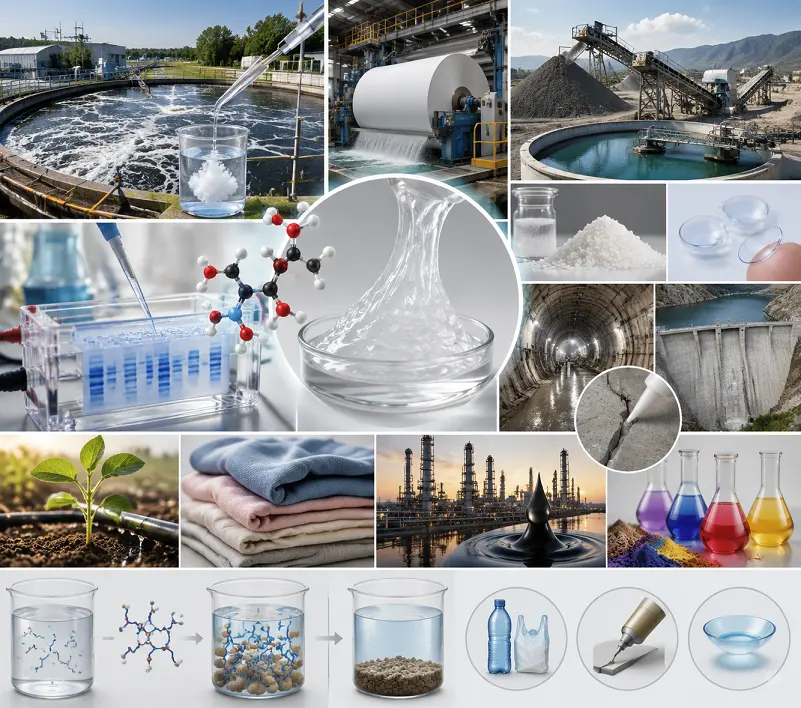
The primary application of acrylamide is in the manufacture of polyacrylamides, which account for more than 90% of total acrylamide consumption. In the United States, approximately 94% of acrylamide is converted into polyacrylamides, which are mainly used for water treatment (about 56% of the total).
Polyacrylamides are used as dewatering aids in municipal wastewater treatment and in industrial effluents such as pulp and paper mill wastewater. They also serve as flocculants for industrial feed water purification.
The pulp and paper industry accounts for approximately 24% of polyacrylamide demand, and mineral processing consumes around 10%. Another 6% is used in the synthesis of N-methylacrylamide and other specialty monomers. The remaining 4% is for miscellaneous applications.
Copolymers of acrylamide are used in the production of plastics, adhesives, food packaging materials, and contact lenses.
In construction, acrylamide copolymers are used in grouting formulations for dam foundations, tunnels, and sewers due to their ability to form impermeable barriers.
In laboratory research, acrylamide is used to prepare polyacrylamide gels for electrophoresis, an essential technique in molecular biology and genetic engineering for the separation of nucleic acids and proteins.
Other uses acrylamide include soil conditioning agents for agriculture, permanent-press finishes in textiles, additives in crude oil processing, and intermediates in the production of dyes and organic chemicals.
5. Toxicology and occupational health
Effects assessment
Acrylamide produces both local and systemic effects in humans and laboratory animals. Contact with the skin causes irritation. Repeated or prolonged exposure leads to neurological disorders, particularly peripheral neuropathy, which develops after a latency period due to accumulation of acrylamide bound to proteins in nervous tissue and hemoglobin.
A two-year study in rats exposed to acrylamide in drinking water identified a lowest observed effect level (LOEL) of 0.5 mg/kg body weight per day for peripheral neuropathy. Acrylamide is absorbed following oral, dermal, and inhalation exposure.
In rats, the major metabolic pathway is the conjugation of acrylamide with glutathione, followed by urinary excretion of the conjugate. A secondary pathway involves cytochrome P450 2E1, which converts acrylamide into the epoxide glycidamide.
Both acrylamide and glycidamide bind to proteins and form hemoglobin adducts. Glycidamide also interacts with DNA and is regarded as the genotoxic and carcinogenic metabolite. Species differences are significant: mice produce more glycidamide than rats, while humans appear to form less than rats.
These metabolic differences explain the higher tumor incidence in mice compared with rats and suggest that humans are less sensitive than rodents.
Chronic exposure in rats increased incidences of thyroid adenomas, testicular mesotheliomas, adrenal pheochromocytomas, mammary fibroadenomas, oral cavity hyperplasia, and astrocytomas. The lowest effective dose for tumor formation in these studies was 1–2 mg/kg body weight per day. In mice, topical application of acrylamide induced skin tumors.
Epidemiological data in humans have not shown a clear association with cancer, although the relatively weak carcinogenic potency observed in animals and the limitations of human studies may prevent detection of small increases in risk. Acrylamide is classified as genotoxic.
In bacterial assays, glycidamide but not acrylamide induces mutations. In mammalian cell systems, acrylamide produces chromosomal aberrations, micronuclei, sister chromatid exchanges, polyploidy, and related cytogenetic abnormalities. In vivo tests, including bone marrow chromosome aberration and micronucleus assays, were also positive.
The evidence from long-term animal studies, combined with genotoxicity data and metabolic activation to glycidamide in humans, indicates that acrylamide has carcinogenic potential. The International Agency for Research on Cancer (IARC), the European Union, and several national agencies classify acrylamide as probably carcinogenic to humans (Group 2B).
Reproductive studies in rats identified a no observed adverse effect level (NOAEL) of 5 mg/kg body weight per day for reduced fertility and 2 mg/kg body weight per day for early embryonic death.
Exposure
Food is a major source of acrylamide exposure in the general population. In 2002, high levels were reported in fried and baked carbohydrate-rich foods, including potato chips, crisps, bread, and crispbread. Acrylamide was not detected in boiled foods.
The European Commission’s Scientific Committee on Food estimated average human intake at approximately 1 μg/kg body weight per day, with some food samples containing up to 3000 μg/kg. Subsequent studies confirmed these findings in multiple European countries.
Acrylamide formation is attributed to high-temperature reactions in carbohydrate-rich materials, although the influence of food processing and preparation methods on its formation is not fully understood.
Occupational exposure occurs during the production of acrylamide and polyacrylamide, during grouting operations, and in laboratories when preparing polyacrylamide gels. Low concentrations have been measured in drinking water treated with polyacrylamide flocculants and in cosmetics containing polyacrylamides.
Risk characterization
Neurotoxicity, reproductive toxicity, and carcinogenicity of acrylamide are the primary health concerns. The NOEL for neurotoxicity is 0.5 mg/kg body weight per day, and for reproductive effects it is 2 mg/kg body weight per day. With an estimated daily dietary intake of 1 μg/kg, the margin of safety (MOS) for neurotoxicity is approximately 500.
Because of acrylamide genotoxicity, a threshold for carcinogenic effects cannot be defined. Linear extrapolation from animal studies estimates that lifelong exposure to 1 μg/kg body weight per day over 70 years corresponds to a cancer risk of about 1 in 1000.
Occupational exposure limits include a threshold limit value-time weighted average (TLV-TWA) of 0.03 mg/m³ with a skin notation and no short-term exposure limit (STEL). Acrylamide is listed by ACGIH as an animal carcinogen (A3). The German technical exposure limit (TRK) is 0.06 mg/m³. IARC classifies acrylamide as a Group 2B probable human carcinogen.
References
1. Habermann, C.E. (2002). Acrylamide. In Kirk-Othmer Encyclopedia of Chemical Technology, (Ed.). https://doi.org/10.1002/0471238961.0103182508010205.a01.pub2
2. Ohara, T., Sato, T., Shimizu, N., Prescher, G., Schwind, H., Weiberg, O., Marten, K., Greim, H., Shaffer, T.D. and Nandi, P. (2025). Acrylic Acid and Derivatives. In Ullmann’s Encyclopedia of Industrial Chemistry. https://doi.org/10.1002/14356007.a01_161.pub4
3. Rashedinia, M.; Karimi, G. Acrylamide. In Encyclopedia of Toxicology, 4th ed.; Wexler, P., Ed.; Academic Press, 2024; pp 125–133. DOI: 10.1016/B978-0-12-824315-2.00164-0
4. Mills, C., Mottram, D.S. and Wedzicha, B.L. (2008). Acrylamide. In Process-Induced Food Toxicants (eds R.H. Stadler and D.R. Lineback). https://doi.org/10.1002/9780470430101.ch2a