Urea: Properties, Reactions, Production and Uses
What is urea?
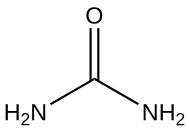
Urea, also known as carbamide or carbonic diamide, is an organic compound with the chemical formula CO(NH2)2. At room temperature, it is a colorless, odorless and tasteless solid. Pure urea crystallizes as long, thin, white needles, although rhomboid prisms are also observed.
Urea takes part in many biological processes, including the breakdown of proteins. The human body produces 20–30 g of urea per day as a waste product.
Rouelle isolated urea from urine in 1773. In 1828, Friedrich Wöhler synthesized it from ammonia and cyanic acid in aqueous solution. Urea was later obtained in 1870 by heating ammonium carbamate in a sealed tube. Research on its preparation has advanced steadily since these early studies.
Modern industrial production is based on the Basaroff synthesis, in which ammonium carbamate is dehydrated at elevated temperature and pressure:
NH2COONH4 ⇌ CO(NH2)2 + H2O
At the beginning of the 20th century, urea was manufactured by hydration of cyanamide, which was derived from calcium cyanamide:
CaCN2 + H2O + CO2 → CaCO3 + CNNH2
CNNH2 + H2O → CO(NH2)2
In the Haber–Bosch ammonia process (1913) ammonia and carbon dioxide were both generated during ammonia synthesis, so urea production from these two compounds expanded rapidly:
2 NH3 + CO2 ⇌ NH2COONH4
NH2COONH4 ⇌ CO(NH2)2 + H2O
Today, all industrial urea is prepared by reactions that follow this mechanism. Ammonium carbamate is formed by direct reaction of ammonia with carbon dioxide and is then dehydrated to urea at elevated temperature and pressure. Carl Bosch developed the high-pressure chemical method while establishing the new ammonia industry and received the Nobel Prize in 1932.
Urea is manufactured worldwide on a very large scale, and annual production exceeded 150 × 106 t in 2010. Its main application is fertilizer. As the most important nitrogenous fertilizer, urea makes a major contribution to the global food supply. Further applications include cattle-feed supplements and the manufacture of resins, glues, melamine, solvents and some medicinal products. Urea also reduces NOx emissions through catalytic reduction. It is classified as a nontoxic compound.
1. Physical properties of urea
Pure urea forms white, odorless crystals in the shape of long, thin needles or rhomboid prisms. The crystal lattice is tetragonal–scalenohedral with an axis ratio a : c = 1 : 0.833. The crystal is anisotropic (noncubic) and therefore shows birefringence. Its refractive indices at 20 °C are 1.484 and 1.602.
The melting point of urea is 132.6 °C, and values of 133–134 °C are also reported. The heat of fusion is 13.61 kJ/mol. The general properties of urea are listed in Table 1.
Table 1: Physical properties of urea
| Property | Value |
|---|---|
| CAS number | 57-13-6 |
| Chemical formula | CO(NH2)2 |
| Molecular weight | 60.056 g/mol |
| Melting point | 133–134 °C |
| Refractive index, nD20 | 1.484, 1.602 |
| Density, d420 | 1.3230 g/cm3 |
| Crystal system and habit | Tetragonal; needles or prisms |
| Free energy of formation at 25 °C | −197.15 kJ/mol |
| Heat of fusion (endothermic) | 251 J/g |
| Heat of solution in water (endothermic) | 243 J/g |
| Heat of crystallization, 70% aqueous urea solution (exothermic) | 460 J/g |
| Bulk density | 0.74 g/cm3 |
| Specific heat at 0 °C | 1.439 kJ kg−1 K−1 |
| Specific heat at 50 °C | 1.661 kJ kg−1 K−1 |
| Specific heat at 100 °C | 1.887 kJ kg−1 K−1 |
| Specific heat at 150 °C | 2.109 kJ kg−1 K−1 |
The physical properties of molten urea at 135 °C are given in Table 2.
Table 2: Physical properties of molten urea at 135 °C
| Property | Value |
|---|---|
| Density, ρ | 1247 kg/m3 |
| Molecular volume | 48.16 × 10⁻³ m3/kmol |
| Dynamic viscosity, η | 3.018 mPa·s |
| Kinematic viscosity, ν | 2.42 × 10⁻⁶ m2/s |
| Molar heat capacity, Cp | 135.2 J mol−1 K−1 |
| Specific heat capacity, cp | 2.25 kJ kg−1 K−1 |
| Surface tension, γ | 66.3 × 10⁻³ N/m |
Between 133 and 150 °C, the density and dynamic viscosity of a urea melt follow these equations, where T is the absolute temperature in kelvin:
ρ = 1638.5 − 0.96T
ln η = 6700/T − 15.311
The density of solid urea at 20 °C is 1335 kg/m3, and its temperature dependence is 0.208 kg m−3 K−1.
Between 240 and 400 K, the molar heat capacity of solid urea is described by:
Cp = 38.43 + 4.98 × 10⁻²T + 7.05 × 10⁻⁴T2 − 8.61 × 10⁻⁷T3
The vapor pressure of solid urea between 56 and 130 °C is given by:
ln Pv = 32.472 − 11 755/T
Urea is hygroscopic. Between 10 and 80 °C, the water vapor pressure above a saturated aqueous urea solution depends on temperature as follows:
ln PH2O°(s) = 175.766 − 11 552/T − 22.679 ln T
The critical relative humidity (CRH) is calculated from this value and the vapor pressure of pure water, PH2O°:
CRH = (PH2O°(s)/PH2O°) × 100
The CRH is the threshold above which urea begins to absorb moisture from the surrounding air. It decreases with rising temperature: 76.5% at 25 °C, 74.3% at 30 °C and 69.2% at 40 °C.
At 25 °C and concentrations of 0–20 mol of urea per kilogram of water, the integral heat of solution of urea crystals in water (ΔHs) depends on the molality m according to:
ΔHs = 15.351 − 0.3523m + 2.327 × 10⁻²m2 − 1.0106 × 10⁻³m3 + 1.8853 × 10⁻⁵m4
Urea and water form a eutectic mixture containing 67.5 wt% water. The eutectic point is −11.5 °C.
The solubility of urea in water, ammonia, methanol and ethanol increases with temperature, as shown in Table 3.
Table 3: Solubility of urea in various solvents (wt% urea)
| Solvent | 0 °C | 20 °C | 40 °C | 60 °C | 80 °C | 100 °C |
|---|---|---|---|---|---|---|
| Water | 39.5 | 51.8 | 62.3 | 71.7 | 80.2 | 88.1 |
| Ammonia | 34.9 | 48.6 | 67.2 | 78.7 | 84.5 | 90.4 |
| Methanol | 13.0 | 18.0 | 26.1 | 38.6 | – | – |
| Ethanol | 2.5 | 5.1 | 8.5 | 13.1 | – | – |
Table 4 gives the properties of saturated aqueous urea solutions.
Table 4: Properties of saturated aqueous solutions of urea
| Temperature, °C | Solubility, g/100 g solution | Density, g/cm3 | Viscosity, mPa·s | H2O vapor pressure, kPa |
|---|---|---|---|---|
| 0 | 41.0 | 1.120 | 2.63 | 0.53 |
| 20 | 51.6 | 1.147 | 1.96 | 1.73 |
| 40 | 62.2 | 1.167 | 1.72 | 5.33 |
| 60 | 72.2 | 1.184 | 1.72 | 12.00 |
| 80 | 80.6 | 1.198 | 1.93 | 21.33 |
| 100 | 88.3 | 1.210 | 2.35 | 29.33 |
| 120 | 95.5 | 1.221 | 2.93 | 18.00 |
| 130 | 99.2 | 1.226 | 3.25 | 0.93 |
Table 5 lists the properties of saturated solutions of urea in liquid ammonia.
Table 5: Properties of saturated solutions of urea in ammonia
| Temperature, °C | Urea in solution, wt% | Vapor pressure of solution, kPa |
|---|---|---|
| 0 | 36 | 405 |
| 20 | 49 | 709 |
| 40 | 68 | 952 |
| 60 | 79 | 1094 |
| 80 | 84 | 1348 |
| 100 | 90 | 1267 |
| 120 | 96 | 507 |
Table 6 shows the composition and density of saturated urea solutions in methanol and ethanol.
Table 6: Properties of saturated solutions of urea in methanol and ethanol
| Temperature, °C | Methanol | Ethanol | ||
|---|---|---|---|---|
| Urea, wt% | Density, g/cm3 | Urea, wt% | Density, g/cm3 | |
| 20 | 22 | 0.869 | 5.4 | 0.804 |
| 40 | 35 | 0.890 | 9.3 | 0.804 |
| 60 | 63 | 0.930 | 15.0 | 0.805 |
2. Chemical reactions of urea
Urea hydrolyzes very slowly in water. The first product is ammonium carbamate, which eventually breaks down into ammonia and carbon dioxide.
Solid urea is stable at room temperature and atmospheric pressure. At atmospheric pressure and at its melting point, it decomposes to ammonia, biuret, cyanuric acid, ammelide and triuret. Biuret is the main by-product of commercial urea and the least desirable one. Excess biuret in fertilizer-grade urea is reported to harm plant growth.
Upon heating, urea decomposes mainly to ammonia and isocyanic acid (HNCO). The gas phase above a urea solution therefore contains a considerable amount of HNCO once the isomerization equilibrium in the liquid phase has been reached:
CO(NH2)2 ⇌ NH4NCO ⇌ NH3 + HNCO
In dilute aqueous solution, the HNCO hydrolyzes mainly to NH3 and CO2. In a concentrated solution or a urea melt, it reacts further with urea at relatively low temperature. The products are biuret (NH2–CO–NH–CO–NH2), triuret (NH2–CO–NH–CO–NH–CO–NH2) and cyanuric acid (HNCO)3. At higher temperature, guanidine [CNH(NH2)2], ammelide [C3N3(OH)2NH2], ammeline [C3N3OH(NH2)2] and melamine [C3N3(NH2)3] also form.
Melamine can also be made from urea by a catalytic gas-phase reaction. Urea is first decomposed to ammonia and isocyanic acid at low pressure, and these are then converted catalytically to melamine.
Heating urea under vacuum at its melting point causes it to sublime without change. At 180–190 °C under vacuum, urea sublimes and converts to ammonium cyanate (NH4OCN). When solid urea is heated rapidly in a stream of gaseous ammonia at elevated temperature and a pressure of several hundred kPa (several atm), it sublimes completely. Part of it decomposes to cyanic acid and ammonium cyanate.
Solid urea dissolves in liquid ammonia and forms the unstable compound urea–ammonia, CO(NH2)2⋅NH3, which decomposes above 45 °C.
Urea–ammonia forms salts with alkali metals, for example NH2CONHM or CO(NHM)2.
Low ammonia partial pressure, high temperature and prolonged heating favor the conversion of urea to biuret. At 10–20 MPa (100–200 atm), heating biuret with ammonia gives urea.
Urea behaves as a monobasic substance and forms salts with acids. With nitric acid it gives urea nitrate, CO(NH2)2⋅HNO3, which decomposes explosively on heating.
In the presence of sodium hydroxide, urea reacts with silver nitrate to form a pale-yellow diargentic derivative. NaOH first converts urea to its imidol form, and this form then reacts with AgNO3. Oxidizing agents in the presence of NaOH convert urea to nitrogen and carbon dioxide. The CO2 reacts with NaOH to give sodium carbonate:
NH2CONH2 + 2NaOH + 3NaOBr → N2 + 3NaBr + Na2CO3 + 3H2O
Urea reacts with alcohols to give carbamic acid esters, commonly called urethanes:
NH2CONH2 + ROH → NH2COOR + NH3
Urea and hydrogen peroxide form urea peroxide, CO(NH2)2⋅H2O2. This white crystalline powder is an oxidizing agent sold under the trade name Hypersol.
Urea and malonic acid give barbituric acid, a key compound in medicinal chemistry.

Urea also reacts with nitrogen oxides (NOx) to form N2, CO2 and H2O. The reaction proceeds in the gas phase at 800–1150 °C and in the liquid phase at lower temperature. It is used industrially to remove NOx from combustion gases.
The products of urea and formaldehyde depend on the pH of the solution and on the molar ratio of the two reactants. Under acidic conditions, urea gives methyleneurea, dimethyleneurea, trimethyleneurea, tetramethyleneurea and polymethyleneureas. Methyleneurea reacts with further formaldehyde molecules to give dimethyleneurea and other homologues. These products are used as slow-release fertilizers under the generic name ureaform.
Under basic conditions, methylolurea (NH2CONHCH2OH) forms instead of methyleneurea. It reacts with more formaldehyde to give dimethylolurea, CO(NHCH2OH)2 (HOCH2NHCONHCH2OH), and higher polymerization products. This chemistry is widely used to produce synthetic resins. Urea is also the raw material for melamine, which is needed for melamine–formaldehyde resins. It is therefore the most important building block of amino resins.
When urea is applied to soil as fertilizer, the enzyme urease hydrolyzes it to NH3 and CO2. Bacteria then convert the NH3 to nitrate, which the crops absorb.
3. Industrial production of urea
Industrially, urea is produced via the two-step Basarov process by reacting ammonia with carbon dioxide at elevated temperatures (170–220 °C) and pressures (125–250 bar):
- Ammonium carbamate formation: This step is rapid, highly exothermic (ΔH ≈ -159 kJ/mol at standard conditions), and proceeds near completion under synthesis pressure. Released heat is recovered for steam generation.
- Carbamate dehydration: This endothermic step (ΔH ≈ +31.4 kJ/mol) occurs exclusively in the liquid phase and is limited by chemical equilibrium, requiring adequate residence time at elevated temperatures.
Because carbamate formation generates significantly more heat than dehydration absorbs, the overall urea synthesis process is exothermic. Operating pressures are maintained above the dissociation threshold of ammonium carbamate to prevent decomposition back to gas.
Maintaining an excess NH3 to CO2 molar ratio (typically 2.9 to 4.5) near the positive azeotropic point minimizes total vapor pressure, maximizes per-pass urea conversion, and suppresses secondary biuret and isocyanic acid formation. Water in the reactor severely inhibits carbamate dehydration, making the reduction of water recycle into the synthesis loop essential.
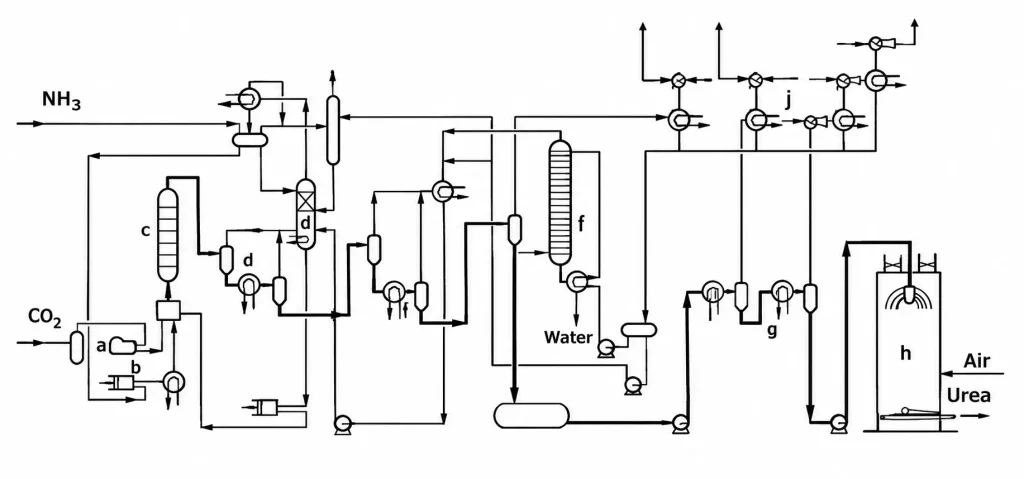
a) CO2 compressor; b) High-pressure ammonia pump; c) Urea reactor; d) Medium-pressure decomposer; e) Ammonia-carbamate separation column; f) Low-pressure decomposer; g) Evaporator; h) Prilling; i) Desorber (wastewater stripper); j) Vacuum condensation section
3.1. High-pressure urea synthesis technologies
Over 90 % of modern industrial facilities employ high-pressure stripping technology where unconverted carbamate is decomposed and recycled directly at synthesis pressure, avoiding energy losses associated with depressurization and aqueous recycling:
1. Saipem (Snamprogetti) thermal stripping uses thermal energy alone at 200–210 °C inside a falling-film stripper to decompose carbamate without an auxiliary stripping gas. Operating at approximately 15 MPa with a feed NH3/CO2 molar ratio of 3.5, the process uses medium-pressure (1.8 MPa) and low-pressure (0.4 MPa) recovery stages, alongside an MP absorber column that recovers pure liquid ammonia for recycle. High-temperature corrosion is mitigated using bimetallic (zirconium and 25-22-2 stainless steel) or OmegaBond tubes.
2. Stamicarbon CO2 stripping operates at approximately 14 MPa with a 2.95:1 NH3/CO2 feed ratio, introducing fresh CO2 gas as a stripping agent. Unreacted gases condense in a high-pressure carbamate condenser, producing low-pressure steam for downstream operations and eliminating the need for a medium-pressure recovery section. Advanced process designs incorporate pool condensers, pool reactors, or AVANCORE low-level layouts fabricated from Safurex duplex stainless steel.
3. Toyo Engineering Corporation (ACES21) combines CO2 stripping with a vertical submerged carbamate condenser (VSCC) and a liquid NH3-driven high-pressure ejector for fluid circulation. Equipment is constructed from corrosion-resistant DP28W duplex stainless steel, permitting a low-level plant layout.
3.2. Product finishing operations
The synthesized urea solution (70–85 wt% aqueous urea) is concentrated and solidified into commercial product forms via three primary finishing methods:
- Prilling: Evaporates the solution to a 99.6 wt% urea melt, which is atomized down a 60–110 m tower against countercurrent cooling air. Prills exhibit lower mechanical crushing strength than granules, often requiring formaldehyde additives or seeding agents to prevent degradation and caking during transport.
- Granulation: Accretes liquid urea melt onto seed particles in fluid-bed or drum granulators. Granules possess superior mechanical strength, larger particle diameters, and reduced dust emissions, making granulation the preferred method for large-scale export plants.
- Pastillation (Rotoform): Deposits molten urea droplets onto a cooled steel belt. This process operates with low energy consumption and minimal environmental emissions, making it ideal for technical-grade urea, pharmaceutical applications, or specialty fertilizer blends containing sulfur or ammonium sulfate.
Explore the step-by-step manufacturing process in our full guide on industrial production of urea.
4. Uses of urea

Urea is an organic chemical compound widely used across agricultural, chemical, and industrial sectors. Over 90 % of global production is applied as agricultural fertilizer. Other primary applications include thermosetting resin production, melamine synthesis, selective catalytic reduction of nitrogen oxides, non-protein nitrogen supplementation in ruminant livestock feed, hydrocarbon separation via inclusion complexes, and specialized chemical formulations.
4.1. Fertilizer and agronomic applications
Urea is the predominant solid nitrogenous fertilizer globally due to its high nitrogen concentration of 46 wt% N. Nitrogen serves as a primary constituent of amino acids, proteins, nucleic acids, and cellular structures in vegetation. Adequate nitrogen supply enhances root elongation, shoot proliferation, biomass accumulation, and the uptake of accompanying plant nutrients.
The high nutrient density of urea minimizes transportation, storage, and handling expenses per unit mass of nitrogen compared to other solid nitrogenous fertilizers. This economic efficiency makes urea an essential input for maintaining global food production.
4.1.1. Nitrogen use efficiency and environmental impact
Plant uptake efficiency for applied urea ranges between 30 % and 60 %. The unabsorbed portion is lost via nitrate (NO3–) leaching into soil subsurface layers or gaseous ammonia volatilization into the atmosphere. Nitrogen losses reduce agricultural efficiency and induce aquatic eutrophication, leading to oxygen depletion and excessive algal growth in rivers, lakes, and marine ecosystems.
Strategies to minimize environmental nitrogen losses include:
- Optimizing agronomic practices and providing technical training to farm operators. Transferring efficient agricultural technologies to developing regions is critical, where farming is predominantly small-scale and decentralized.
- Utilizing slow-release and controlled-release urea formulations.
- Employing deep-placement techniques, such as urea supergranules.
4.1.2. Formulation types and processing methods
Commercial urea for soil application is supplied as prills or granules containing 0.8–2.0 wt% biuret. Low-biuret grades (maximum 0.3 wt% biuret) are dissolved in water for foliar liquid sprays to avoid leaf necrosis.
Urea serves as a nitrogen source in compound fertilizer manufacturing. Production involves mixing urea melts or aqueous solutions prior to granulation, or dry-blending solid urea prills and granules with other solid fertilizers. Dry bulk blending requires matching granule sizes to prevent physical segregation during transport. Chemical compatibility must be controlled; mixtures of urea and ammonium nitrate are highly hygroscopic and susceptible to extreme caking.
Common compound formulations include urea–ammonium phosphate, urea–ammonium sulfate, and urea–phosphate. Concentrated urea–ammonium nitrate liquid solutions (80–85 wt%) exhibit high nitrogen content and low crystallization temperatures, enabling efficient pipeline conveyance, bulk transport, and direct liquid field application.
4.2. Polymer and synthetic resin production
4.2.1. Urea–Formaldehyde resins
Condensation reactions between urea and formaldehyde produce thermosetting urea–formaldehyde amino resins. These materials serve as adhesives and binders in engineered wood products (particleboard, plywood), molding powders, surface varnishes, and insulating foams. They are also applied as surface treatments and impregnating agents for paper, textiles, and leather.
4.2.2. Melamine synthesis
Urea is the primary chemical feedstock for industrial melamine production via high-temperature, high-pressure thermal pyrolysis. Ammonia generated as a co-product is recycled directly back into the urea synthesis loop to optimize process efficiency. Melamine reacts with formaldehyde to form melamine–formaldehyde resins, which are used in decorative laminates, high-durability coatings, molding compounds, adhesives, and textile or paper processing.
4.3. NOx emission control (selective catalytic reduction)
Aqueous urea solutions are used as chemical reducing agents in selective catalytic reduction systems to abate nitrogen oxide (NOx) emissions from diesel engines and stationary combustion sources. Injected into hot exhaust gas streams, urea undergoes thermal decomposition and hydrolysis to yield ammonia. The generated ammonia selectively reacts over a catalyst to convert NOx into molecular nitrogen and water vapor.
4.4. Ruminant animal nutrition
Ruminant livestock (cattle, sheep) utilize urea as a non-protein nitrogen source. Microorganisms within the rumen express urease enzymes that hydrolyze urea into ammonia, which is subsequently incorporated into microbial protein. Urea supplementation in livestock feed is widely implemented in North America, whereas its use in Western Europe is limited. Urea is also used as a nitrogen source in the industrial fermentation of L-lysine, an essential amino acid used in poultry feed formulations.
4.5. Hydrocarbon separation via inclusion clathrates
Reagent-grade urea forms host-guest crystalline inclusion complexes (clathrates) with straight-chain, unbranched organic molecules (n-alkanes). During crystallization, urea molecules assemble into a helical structural network with cylindrical channels that encapsulate linear hydrocarbons. The channel diameter varies with crystallization temperature, allowing selective separation based on carbon chain length.
This inclusion property is applied in petroleum refining to manufacture low-pour-point jet aviation fuels and perform dewaxing of lubricating oils. The clathrate host structure is dissociated by dissolving the urea matrix in water or alcohols.
4.6. Medical uses of urea
In medicine, urea is used as an osmotic agent to lower elevated intraocular pressure associated with glaucoma. It is also administered as an osmotic diuretic to increase urine output.
Applied topically, urea treats psoriasis and other conditions characterized by dry, scaly skin. High-concentration creams (45% urea) are formulated to debride hyperkeratotic surface lesions and support normal skin healing, particularly when recovery is delayed by localized infection, necrotic tissue, fibrinous or purulent debris, or eschar. Urea works by breaking down the intercellular matrix, which loosens the stratum corneum and promotes gradual shedding of scaly tissue, thereby softening thickened regions.
A similar mechanism applies to the nail plate: urea hydrates and breaks down the intercellular matrix, softening the nail structure to facilitate non-surgical debridement over time.
4.7. Miscellaneous industrial uses
Urea is used in various specialized industrial formulations and processes:
- Solubilizing agent for protein and starch denaturation in biochemical processing.
- Active ingredient and stabilizer in pharmaceutical, dermatological, cosmetic, and toothpaste preparations.
- Viscosity modifier in petroleum processing, as well as casein- and starch-based paper coatings.
- Constituent in printing inks, pesticides, fabric softeners, and flame-retardant materials.
- Nitrogenous nutrient supplement in commercial bioprocessing, fermentation, and brewing.
- Non-corrosive de-icing agent for airport runways.
References
1. Brouwer, M. Urea. In Kirk-Othmer Encyclopedia of Chemical Technology; John Wiley & Sons, Inc., 2019. DOI: 10.1002/0471238961.2118050113012218.a01.pub3.
2. Meessen, J. H. Urea. In Ullmann’s Encyclopedia of Industrial Chemistry; Wiley-VCH, 2010. DOI: 10.1002/14356007.a27_333.pub2.
3. Meessen, J. “Urea synthesis.” Chem. Ing. Tech., 2014, 86 (12), 2180–2189. DOI: 10.1002/cite.201400064.
4. Masjedi, S. K.; Kazemi, A.; Moeinnadini, M.; Khaki, E.; Olsen, S. I. “Urea production: An absolute environmental sustainability assessment.” Sci. Total Environ., 2024, 908, 168225. DOI: 10.1016/j.scitotenv.2023.168225.
5. Wang, H.; Ran, J.; Jiang, T. Urea. In Urea Transporters; Yang, B., Sands, J., Eds.; Subcellular Biochemistry, Vol. 73; Springer, 2014. DOI: 10.1007/978-94-017-9343-8_2.
6. Mamoulakis, C.; Georgiadis, G.; Fragkiadoulaki, E. Urea. In Encyclopedia of Toxicology, 4th ed.; Wexler, P., Ed.; Academic Press, 2024; pp 685–692. DOI: 10.1016/B978-0-12-824315-2.00759-4.