
How to handle 50+ papers for a thesis without losing your mind
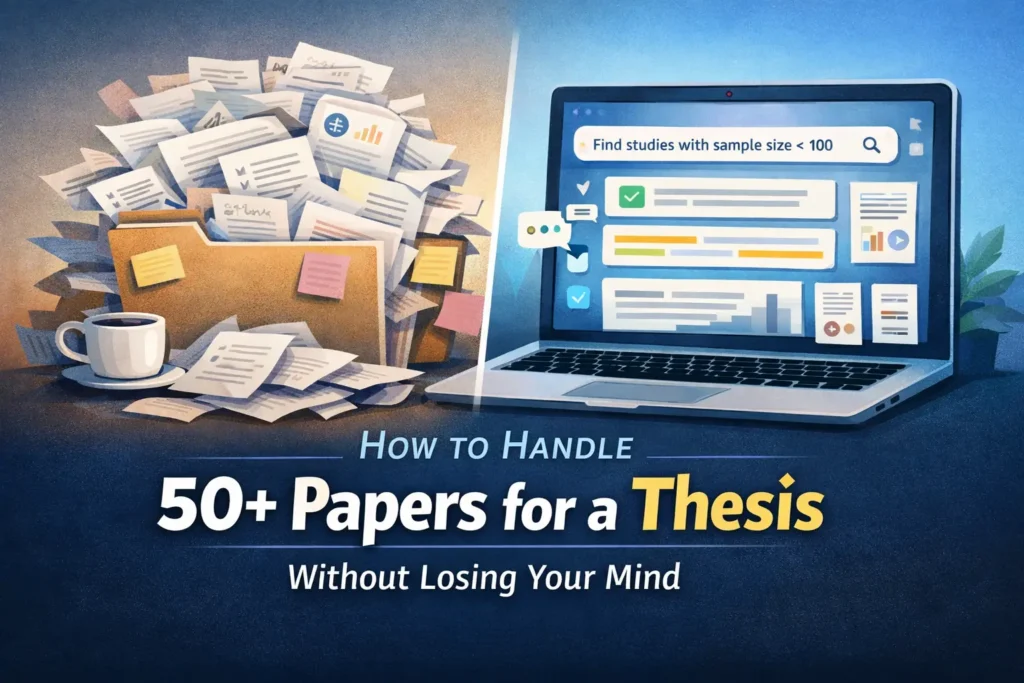
If you’re working on a thesis, there’s a moment that almost everyone reaches—but few talk about openly.
It’s the moment when your carefully curated reading list turns into a graveyard of PDFs.
They sit there quietly. Dozens of them. Papers you know are important. Papers you fully intend to read. Papers that somehow never quite move beyond the abstract.
At first, it feels like a motivation problem.
Later, you realize it’s something else entirely.
This isn’t about discipline or intelligence. It’s about scale.
Once your literature review passes a certain size, success no longer comes from reading harder. It comes from building a system that lets you extract meaning without drowning in information.
That shift—from collecting papers to synthesizing them—is what separates a stressful thesis experience from a manageable one.
Table of Contents
- The hidden cost of the “PDF graveyard”
- The first pass that saves dozens of hours
- Why traditional note-taking breaks down after 30 papers
- Step 3: active synthesis (where real thesis work happens)
- Turning research into writing (without starting from zero)
- Conclusion
The hidden cost of the “PDF graveyard”
Here’s the uncomfortable truth most guides don’t mention:
The danger of having 50+ papers isn’t that you won’t read them all.
It’s that you’ll keep re-reading the same ones because you can’t remember where insights live.
That repetition silently drains:
- Time
- Focus
- Confidence in your own understanding
The goal of a strong literature review isn’t exhaustive reading. It’s clarity.
And clarity comes from structure.
The first pass that saves dozens of hours
Why reading papers front-to-back doesn’t scale
Academic papers are not meant to be read like books—especially when you’re managing a PhD-level workload.
Instead of starting at page one, use a triage pass:
- Abstract – What question is this paper actually answering?
- Conclusion / Discussion – What did they claim to find?
- Figures & Tables – What evidence supports those claims?
In under ten minutes, you can decide whether a paper deserves your limited attention.
Classify early, not perfectly
After that first pass, immediately place each paper into one of three categories:
- Core – Directly shapes your argument
- Context – Supports background or framing
- Archive – Useful, but not essential
This single habit dramatically reduces cognitive overload. You stop treating every paper as equally important—because they aren’t.
Serious researchers don’t read everything.
They decide what not to read early.
Metadata is an investment, not a chore
Using a reference manager like Zotero isn’t optional at scale. Clean titles, authors, and keywords early, and your future writing phase becomes exponentially easier.
This is boring work—but it’s the kind that prevents panic later.
Why traditional note-taking breaks down after 30 papers
Highlighters, margin notes, and sticky tabs work beautifully—until they don’t.
The moment your library grows large, two things happen:
- Your insights become fragmented across documents
- Your brain becomes the index
That’s when fatigue sets in.
At this stage, what you need isn’t better notes.
You need contextual recall.
From files to a grounded research workspace
Lately, I’ve been moving my core papers into Anara (linked here), not because it replaces reading—but because it removes friction between papers.
Instead of treating each PDF as an isolated object, Anara lets you work with your entire library as a single, grounded research environment.
That shift changes how you think.
You stop asking:
- Which paper was that in?
And start asking:
- Which of these studies used a sample under n=100?
- Where do authors disagree on methodology?
- Which papers contradict the dominant assumption in the field?
Because answers come directly from your documents, not generic summaries, the tool supports academic rigor instead of undermining it.
This is what “Academic AI” looks like when it’s designed for researchers—not shortcuts.
Step 3: active synthesis (where real thesis work happens)
Most thesis guides focus on reading.
But the hardest part of a literature review is comparison.
This is where many students stall—not because they lack material, but because they can’t clearly articulate how studies relate to each other.
Stop summarizing. Start juxtaposing.
Instead of asking what each paper says, ask:
- How do their methodologies differ?
- What assumptions go unchallenged?
- Which populations are repeatedly excluded?
- Where do findings quietly contradict each other?
These questions reveal the research gap—often without adding a single new paper.
Why AI assistance actually helps here
When you’re comparing dense sections across multiple papers, cognitive fatigue becomes real.
Anara’s assistant is particularly useful at this stage because it can:
- Summarize technical sections on demand
- Compare arguments across papers
- Surface contradictions with direct citations
That last part matters. You’re not outsourcing thinking—you’re reducing mechanical overhead so your energy stays focused on analysis.
Turning research into writing (without starting from zero)
Why the blank page feels so intimidating
“Writer’s block” during a thesis is rarely about writing.
It’s about not knowing how your evidence connects yet.
Once those connections exist, writing becomes documentation—not invention.
Write while context is still alive
One of the most effective shifts you can make is drafting your literature review inside your research environment, while sources and citations are immediately accessible.
This allows you to:
- Write thematically, not paper-by-paper
- Preserve citation accuracy
- Build arguments incrementally
Tools with auto-citation support quietly remove one of the biggest anxiety triggers in academic writing: losing track of where ideas came from.
That alone can save weeks of cleanup.
Conclusion
A thesis isn’t won by working longer hours.
It’s won by building systems that:
- Reduce repetition
- Preserve context
- Protect your cognitive energy
If you’re constantly reopening PDFs, searching for the same terms, or second-guessing citations, your workflow is doing more harm than you realize.
Take a moment to audit how you’re currently working.
If managing your literature still feels manual and fragmented, it may be time to evolve your setup. Tools like Anara aren’t about replacing scholarship—they’re about supporting it at scale, so your effort goes into thinking and writing, not searching.
The sooner your system works with you, the sooner your thesis stops feeling overwhelming.
